You don't need a multi-million dollar tech upgrade to make your guests happy. When travelers ask for a fast, effortless stay, what they’re looking for is a friction-free experience — but that’s not all. Today, 74% of travelers also expect their hotel stays to be personalized, according to Amadeus's Travel Dreams 2026 report.
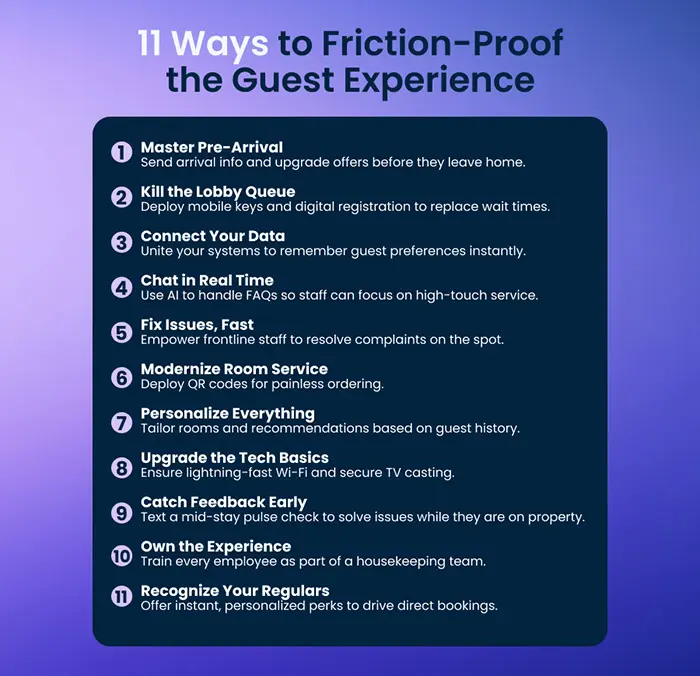
In this guide, we’ll break down how hotels can meet these expectations with 11 ideas to enhance the hotel guest experience (and earn more five-star reviews!). From faster check-in to AI-powered guest communication, these strategies show exactly how to improve the guest experience in hotel processes while driving efficiency and revenue at the same time.
Key highlights:
Guest experience refers to every interaction a traveler has with your hotel, from discovery to post-stay communication.
Hotels improve guest satisfaction when they remove operational friction, personalize service and respond to guest needs faster.
AI-powered tools and automation are reshaping hospitality, with 82% of hoteliers planning to increase AI usage in the next year.
Canary replaces paper forms and manual check-ins with an all-in-one digital system to keep operations smooth.
Here’s How to Improve the Guest Experience in Hotel Processes
If you want more five-star reviews and more revenue, read on to discover 11 ideas to enhance the hotel guest experience.
1. Optimize the Pre-Arrival Communication Workflow
The guest experience starts before a traveler steps onto the property. Strong pre-arrival communication reduces uncertainty, proactively answers common questions and builds excitement ahead of arrival. It also strengthens the overall booking process by giving guests confidence that their stay will be smooth and well-organized.
Having a seamless pre-arrival workflow means far less stress for front desk teams. There’s also an opportunity to drive ancillary revenue before the stay even begins with personalized outreach. You can learn more about building a strong hotel arrival strategy, but here are some ways to improve pre-arrival communication right now:
Trigger automated arrival info 24–48 hours out: Send a clear text detailing check-in times, early arrival policies and a direct link to digital check-in.
Preempt logistics (parking, transit, amenities): Clearly map out parking costs, EV charging availability and transit routes so guests don't have to hunt for information.
Pitch relevant room upgrades and add-ons: Use segmented data to offer targeted upsells like early check-in, breakfast packages or a premium view when excitement is highest.
Push mobile check-in links directly to SMS: A text message with a direct link will perform better than an email buried in a promotions tab.
Tailor the message to the guest’s profile: Acknowledge returning guests with a "welcome back" note that confirms their saved preferences.
2. Streamline Check-In and Front Desk Processes
The arrival experience sets the tone for the entire stay. Long lines, paperwork and slow front desk workflows create frustrating friction for guests (especially given that guest expectations are increasingly digital-first) and increase stress for hotel teams.
Hotels with a simple arrival process improve efficiency while creating a faster, more convenient experience for guests. Updating the check-in process also frees staff to focus on hospitality instead of repetitive tasks. To improve check-in operations:
Move the entire check-in flow online: Let guests complete registration, sign terms and authorize cards on their own devices before they ever reach the lobby.
Ditch registration cards entirely: Replace clipboards and pens with secure digital forms that instantly sync with your Property Management System (PMS).
Deploy smart self-service kiosks: Position intuitive kiosks in the lobby to handle high-volume rushes, letting guests skip the line, verify their identity and cut their own keys.
Automate ID verification and secure payments: Use secure, digital ID scanning and payment capture to eliminate manual typing errors and drastically reduce chargeback risks.
Transition to mobile keys (e-keys): Deliver digital room keys straight to the guest’s smartphone upon room readiness so they can bypass the front desk.
3. Centralize Guest Data for Personalization
Offering personalized service gets tricky when guest information lives across disconnected systems. Without a centralized guest profile, hotel teams often miss opportunities to recognize preferences, tailor communication and anticipate traveler needs.
Unified systems help you easily personalize guest experiences and offer consistent operations across departments. To centralize guest data:
Build a tight PMS, CRM and messaging tech stack: Ensure your core systems talk to each other in real time so housekeeping statuses, guest notes and billing updates flow instantly.
Maintain a single, unified guest profile: Track dietary restrictions, pillow preferences and past complaints in one file rather than across sticky notes and local spreadsheets.
Map stay history across your entire portfolio: If a guest frequently requests a quiet room or a late checkout at one property, make sure that preference automatically populates when they book at a sister location.
Enable cross-department notes in real time: Ensure a guest’s text request for extra towels instantly gets added to housekeeping’s digital dashboard without requiring a radio call.
Drive smart, data-backed upsells: Use historical spend data to suggest relevant offers, like promoting spa openings to a guest who historically books wellness treatments.
4. Implement Real-Time Guest Communication Channels
Guests expect immediate communication throughout their stay, so it’s no surprise that there’s a universal shift toward AI-powered guest messaging. In fact, only 1 out of 500 hoteliers is not planning to invest in AI in 2026, Amadeus reports. The average hotel is earmarking roughly $320,000 for AI tools focused on automation, revenue intelligence and chatbots.
A direct line between guests and staff is still crucial, but automating answers to common requests paves the way for more opportunities to boost satisfaction and generate additional revenue. To improve guest communication:
Open a two-way SMS or WhatsApp channel before arrival: Invite guests to text the hotel for anything they need, establishing a casual, low-friction lifeline throughout their stay.
Deploy an AI assistant for instant FAQ handling: Let conversational AI instantly answer recurring questions so your team can focus on complex requests.
Route digital requests directly to the floor: Ensure text-based requests for items like extra pillows or ice bypass the front desk entirely and route straight to the housekeeping or room service team.
Secure after-hours support with automated triaging: Use AI-powered messaging to handle late-night inquiries, while still instantly escalating urgent issues (like maintenance) to on-duty night staff.
Send proactive, timely operational updates: Reach out via text to inform guests when their room is ready early, when housekeeping is heading their way or when the restaurant has open tables.
5. Standardize Service Recovery Protocols
Even strong hotel operations occasionally experience service issues. What separates exceptional hotels from the rest is how quickly and consistently they resolve guest concerns. A structured recovery process should be professional, reduce confusion and offer a solution that addresses the problem.
A rapid but smart response is the new standard. According to the Shiji Global Guest Experience Benchmark, the widespread adoption of AI review management has driven the average management response time to a record low. For 5-star hotels, the global average response time to a guest review is now just 2.8 days (it was up to 14 days just a few years ago). A proactive recovery strategy ensures guests feel heard, valued and supported throughout the resolution process. To improve service recovery:
Define clear escalation paths for common issues: Establish explicit, step-by-step operating procedures for staff to address standard friction points like loud neighbors, unclean rooms or billing discrepancies.
Train staff on immediate, empathetic acknowledgment: Teach teams to validate the guest's frustration right away, without getting defensive or hiding behind hotel policy.
Empower frontline staff with financial autonomy: Give desk agents and floor staff the authority to waive fees or offer complimentary meals without needing a manager's sign-off.
Close the loop with a formal follow-up: Reach out to the guest a few hours after a resolution to ensure the fix met their expectations before they check out.
Track and analyze recurring complaints: Log every service slip in your CRM to spot operational blind spots, whether it's a specific room with an AC issue or a systemic backup at breakfast.
6. Redesign Room Service Offerings
Traditional room service can feel outdated and inconvenient for modern travelers. Mobile-friendly ordering, real-time updates and customizable dining provide experiences that mirror the convenience they receive from consumer apps.
Hotels that modernize their room service boost convenience and unlock additional revenue. Digital ordering also reduces friction during peak dining periods. To improve room service operations:
Introduce frictionless QR-code ordering: Place unique QR codes on desks and bedside tables so guests can view live menus, order and pay directly from their phones.
Enable digital order customization: Let guests easily add modifiers or note allergies within the mobile ordering interface, reducing order mistakes and phone calls.
Provide live, transparent delivery tracking: Keep guests informed with automated updates, letting them know when their order is being prepared and when it's on its way.
Embed smart upsells into the digital checkout: Program the ordering system to automatically suggest beverage pairings or complementary sides before the order is placed.
Simplify the menu for speed and kitchen efficiency: Focus on high-margin, transportable dishes that hold temperature well, so the kitchen stays agile during peak morning and evening rushes.
7. Personalize In-Stay Experiences
Travelers increasingly expect a personalized experience that reflects their preferences and past behaviors. Hotels that recognize guest preferences throughout the stay create stronger emotional connections and more memorable experiences.
Personalization also improves guest satisfaction by making interactions feel more thoughtful and relevant. From curated recommendations to targeted offers, small details often have the biggest impact on long-term loyalty. To personalize guest stays:
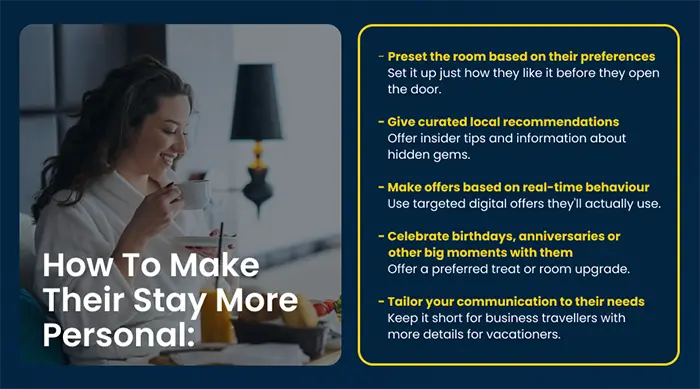
Preset the room based on historical preferences: If a returning guest prefers a high floor, feather-free pillows or a specific temperature, ensure the room is configured that way before they open the door.
Deliver hyper-local, curated recommendations: Provide insider tips on neighborhood dining or hidden spots tailored to a guest’s trip type, whether they are traveling for business or a weekend getaway.
Match in-stay offers to real-time behavior: If a guest asked about coworking space, send a targeted digital offer for a mid-afternoon espresso special or a quiet workspace upgrade.
Acknowledge milestones with thoughtful touches: Don't just leave a generic card for a birthday or anniversary; tailor the gesture with a specific treat or an unexpected upgrade that feels genuinely celebratory.
Vary communication styles across segments: Adapt your tone and touchpoints based on who is staying. Keep things brief and text-based for business travelers, while offering more descriptive, leisure-focused details for vacationers.
8. Improve Hotel Room Technology Infrastructure
In-room technology is just as important as other amenities. Slow Wi-Fi, outdated TVs and disconnected room controls negatively impact the stay experience and influence review scores.
Hotels that invest in modern hospitality technology create more seamless stays while improving operational flexibility behind the scenes. Reliable technology infrastructure is now a core part of the guest experience. To improve room technology:
Invest in high-speed Wi-Fi across the property: Ensure fast, seamless connectivity that doesn't drop as guests move from the lobby to their rooms.
Install casting-enabled smart TVs: Equipping rooms with secure casting tech (like Google Chromecast or Apple AirPlay) allows guests to stream their own Netflix or YouTube accounts safely.
Roll out reliable mobile key entry: Ensure your door hardware is upgraded to support mobile key entry, minimizing the demagnetized keycard walk back to the desk.
Streamline environmental and lighting controls: Replace overly complex smart panels with intuitive, clear controls for lights, shades and thermostats that don't require an instruction manual to operate.
Run proactive tech and connectivity audits: Task maintenance and IT with regular, scheduled checks of in-room bandwidth speeds, remote control battery life and casting security protocols between check-ins.
9. Implement Structured Guest Feedback Loops
Hotels need consistent feedback collection processes to understand what guests value most and where operational improvements are needed. Without structured feedback loops, teams often miss opportunities to resolve problems before negative reviews appear online.
A strong hotel guest feedback strategy creates a continuous improvement cycle that supports both guest satisfaction and operational performance. To improve guest feedback collection:
Deploy brief, post-stay digital surveys within 24 hours: Send a highly focused, short survey right after checkout while the details of the experience are fresh in the guest’s mind.
Centralize review management across major platforms: Use a unified reputation dashboard to track, organize and quickly respond to feedback from Google, Booking.com and Tripadvisor.
Check in mid-stay via text: Send an automated text on day two ("How is everything with your room so far?") to catch and fix minor annoyances before checkout.
Synthesize feedback into actionable operational trends: Tag data weekly to uncover broader issues, such as a drop in breakfast service scores or recurring issues with hot water on certain floors.
Share insights across the entire operational team: Bring raw customer feedback data into weekly department head meetings, ensuring housekeeping, maintenance and F&B know exactly where they are winning and where they need to pivot.
10. Train Staff on Experience Ownership
Every interaction shapes the guest experience, not just front desk conversations. Each staff member plays a role in creating positive stays, whether they work in housekeeping, maintenance, food service or operations.
Hotels that invest in clear communication and coaching create teams that solve problems proactively and deliver more consistent service. Strong staff training strategies also improve confidence and accountability across departments. To improve experience ownership:
Establish cross-department service standards: Ensure every team member is trained on the core fundamentals of guest interaction, from eye contact to body language.
Empower teams to fix issues on the spot: Give housekeepers and floor staff the agency to replace missing items, offer amenities or coordinate quick fixes.
Build a visible, internal culture of recognition: Create a peer-to-peer or manager-led program that publicly rewards staff members who pull off a great save or create a standout guest moment.
Run practical, interactive role-playing workshops: Use real-world hotel scenarios to help staff practice de-escalating tense situations.
Keep guest experience goals front and center daily: Use five-minute shift stand-ups to review daily guest feedback and reinforce the property’s current satisfaction targets.
11. Integrate Loyalty and Returning Guest Programs
Guest retention remains one of the most effective ways to improve hotel profitability. Hotels that create meaningful experiences encourage repeat bookings while strengthening long-term guest relationships.
Strong loyalty initiatives do more than reward points accumulation. Personalized offers, recognition and targeted communication all help build loyalty while increasing direct engagement with your hotel. A modern loyalty program creates more opportunities to drive repeat business and long-term guest value. To strengthen guest loyalty:
Design hyper-personalized offers for direct repeat bookings: Skip the generic promos and send returning guests tailored packages based on what they did during their last stay.
Reward direct bookings with immediate, high-value perks: Give travelers a tangible reason to skip third-party booking sites by offering guaranteed flexible checkouts, complimentary room choices or arrival drinks for booking direct.
Flag repeat travelers automatically at the desk: Ensure your PMS visibly highlights a returning guest's loyalty tier so desk agents can warmly acknowledge their return the second they arrive.
Pitch loyalty membership organically at natural touchpoints: Train your front desk and reservation teams to highlight the immediate, real-time benefits of enrolling during the check-in or checkout conversation.
Send targeted post-stay invitations that drive return intent: Follow up a week after a great stay with a personalized booking link and a preferred rate, catching travelers right as they begin planning their next trip.
Improve Hotel Guest Experience with Canary
Delivering a better guest experience requires a unified platform that simplifies operations, personalizes communication and creates seamless guest interactions from booking through post-stay engagement.
Canary’s guest management software gives hotels a modern Guest Management System designed specifically for hospitality. Trusted by more than 20,000 hoteliers globally, Canary helps hotels improve service, increase revenue and reduce operational strain with AI-powered automation and mobile-first guest experiences.
With Canary, hotels see outcomes like:
Faster guest response times
Reduced lobby congestion during peak check-in hours
Higher guest satisfaction and loyalty
Increased operational efficiency for hotel teams
More direct upsell and ancillary revenue opportunities
Une meilleure visibilité sur les préférences et les comportements des clients
Une productivité accrue du personnel sans compromettre l'hospitalité
Qu'est-ce que la satisfaction client dans l'hôtellerie ?
La satisfaction client mesure le degré de contentement des clients vis-à-vis de leur expérience globale à l'hôtel. Elle reflète la capacité de l'établissement à répondre aux attentes, voire à les dépasser, à chaque étape clé : réservation, enregistrement, qualité des chambres, réactivité du service et communication après le séjour.
Une gestion efficace de la satisfaction client permet aux hôtels d'améliorer leurs notes sur les sites d'avis, de renforcer la fidélité et de générer des réservations récurrentes. Les hôtels suivent généralement la satisfaction client via des enquêtes, des avis en ligne, le Net Promoter Score (NPS) et les retours directs des clients.
Quelle est la différence entre l'expérience client et le service client ?
Le service client désigne les interactions spécifiques entre le personnel de l'hôtel et les clients, comme la résolution de problèmes, les réponses aux questions ou la gestion des demandes. L'expérience client est plus large et englobe chaque interaction du voyageur avec l'hôtel tout au long de son séjour.
L'expérience client commence dès le processus de réservation et se poursuit lors de l'arrivée, de la communication pendant le séjour, du départ et de l'engagement post-séjour. La technologie, la qualité des chambres, la personnalisation et l'efficacité opérationnelle contribuent toutes à l'expérience globale, au-delà des simples interactions de service.
Comment les hôtels peuvent-ils mesurer et analyser l'expérience client ?
Les hôtels mesurent l'expérience client en combinant retours des clients, données opérationnelles et indicateurs de performance. Les outils de mesure courants incluent les enquêtes post-séjour, le suivi de la réputation en ligne, les scores de satisfaction client et l'analyse directe des avis. Les hôtels peuvent également analyser des indicateurs opérationnels liés au parcours client, notamment :
Temps moyen d'enregistrement et de départ
Délais de réponse aux messages des clients
Notes des avis en ligne et tendances de sentiment
Taux de fidélisation
Taux de conversion des ventes additionnelles
Délais de résolution des réclamations
Net Promoter Score
Retours directs des clients via les enquêtes et les plateformes de messagerie